Yin Yoga is a slow, meditative practice. It focuses on the body’s deep connective tissues. These include joints, ligaments, fascia, and bones. In contrast to more vigorous styles of yoga Yin Yoga emphasizes stillness, extended poses, and internal awareness.
At the core of Yin Yoga philosophy is the ancient meridian system from Traditional Chinese Medicine (TCM). Meridians are the pathways where vitality also known as Qi (pronounced “chee”) flows.
Understanding the 12 main meridians in Yin Yoga can help you learn how the body’s energy system works. It can also help you find emotional balance. It can also help you find physical balance.
This article explains meridians and why they matter in Yin Yoga. It also describes each of the 12 meridians in detail.
What Are Meridians?
Meridians are the invisible channels in the body that allow Qi flows. According to TCM the smooth and well-balanced circulation of Qi is vital to well-being and health. If Qi is unbalanced or blocked this can cause mental and physical pain, issues or illnesses.
Twelve primary meridians are each connected to a specific organ system. Yin and Yang link with the meridians, reflecting the fundamental duality that exists in the natural world. Practitioners often link Yin meridians to inner cooling and nourishing effects. They link Yang meridians to outer active and warming effects.
Dum Yin Yogam exerces, positiones fiunt ut hos meridianorum meatus excitent. Ita circulationem Qi stimulat et aequilibrium energiae restituit.
Yin and Yang Meridians
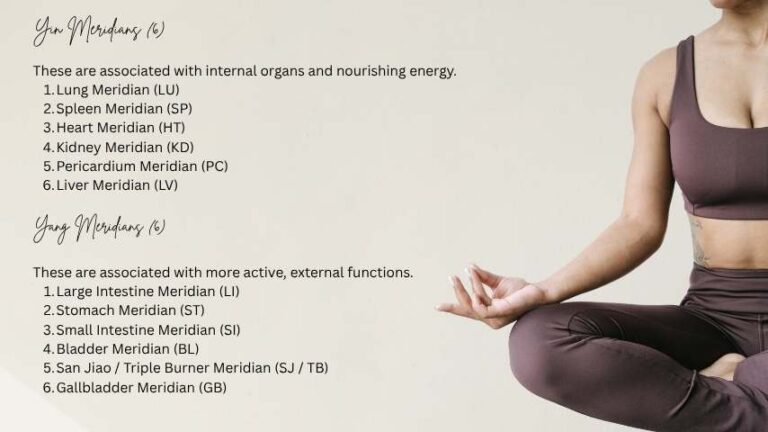
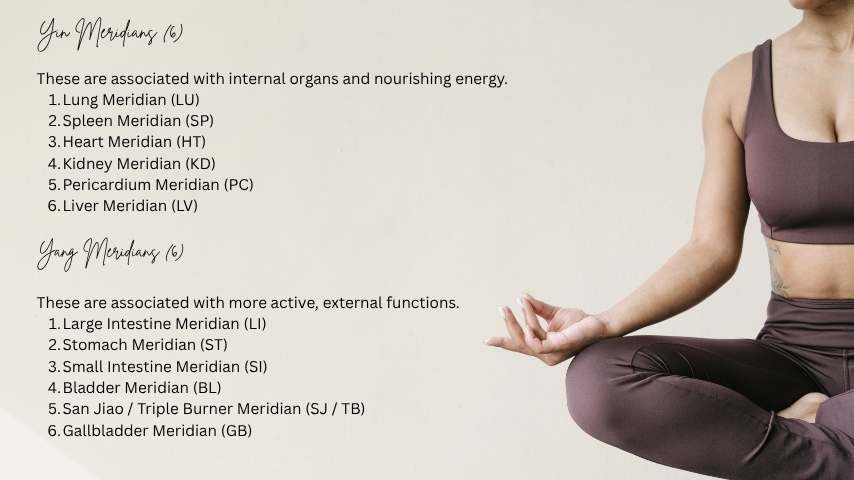
Twelve meridians can be broken down into 6 Yin along with the six Yang meridians:
Yin Meridians:
- Lung
- Spleen
- Heart
- Kidney
- Pericardium
- Liver
Yang Meridians:
- Large Intestine
- Stomach
- Small Intestine
- Bladder
- San Jiao (Triple Burner)
- Gallbladder
The corresponding Yang Meridian joins each Yin Meridian, creating an energetic relationship.
The Role of Meridians in Yin Yoga
In Yin Yoga, poses are held for a few minutes. This gently stresses connective tissues and activates the meridian lines. The reason for this is:
- Increase the flow of energy
- Support organ health
- Increase emotional stability
- Improve joint mobility and flexibility
- Promote deep relaxation
Different Yin poses target particular meridians. For instance forward folds can stimulate kidney and bladder meridians hip openers impact the gallbladder and liver meridians.
The 12 Yin Yoga Meridians Explained
1. Lung Meridian (Yin)
The Lung Meridian runs from the chest through the arms’ interiors up to the thumbs. It links to breathing, immunity, and consuming energy from the life force.
Emotional component: Grief and sadness
Yin Yoga’s center: Heart openers and gentle backbends
When it is balanced When balanced, the Lung Meridian promotes a feeling of vitality and openness.
2. Large Intestine Meridian (Yang)
The meridian stretches through the finger of your index upwards the arm until the face. It’s in close contact with the Lung meridian, and is responsible for eliminating and the release of.
Emotional aspects: Letting go of emotional baggage
Yin Yoga concentration: Twists and shoulder stretch
The balance of this meridian promotes release, both emotionally and physically.
3. Stomach Meridian (Yang)
The Stomach Meridian runs from the face to the front of the body and to the feet. Responsible for digestion and nutrient intake.
Emotional component: Worry and overthinking
Yin Yoga’s main concentration: Backbends and front-body stretch
A healthy Stomach Meridian supports the grounding process and a healthy digestion.
4. Spleen Meridian (Yin)
The meridian runs along the inside of the legs and torso. The Spleen Meridian is linked to digestion. It helps convert energy into nutrients.
Emotional aspects: Overthinking and ciNtaa (anxiety-like thought process)
Yin Yoga concentration: Inner thigh stretches
This meridian helps to maintain mental stability and stability when it is in balance.
5. Heart Meridian (Yin)
The Heart Meridian runs from the heart and down the inner arm, and then to the tiny finger. It regulates blood circulation and emotional wellbeing.
Emotional aspects: Joy and prem (love)
Yin Yoga’s focus: Chest openers and soft arm stretches
A well-balanced Heart Meridian promotes emotional harmony and connects.
6. Small Intestine Meridian (Yang)
The meridian stretches from the finger to the arm, to the shoulder and to the face. The one responsible for distinguishing pure from impure, both physically as well as mentally.
Emotional aspects: Clarity and discernment
Yin Yoga’s main concentration: Shoulder and upper back stretch
It assists in making clear choices and processing experience.
7. Bladder Meridian (Yang)
The Bladder Meridian is the longest and runs from the eye’s inner part down the back up to the feet. It links to the nervous system and controls energy.
Emotional aspects: Fear and stress
Yin Yoga’s concentration: Forward folds and the spine is stretched
The stimulation of this meridian will calm the mind and body.
8. Kidney Meridian (Yin)
It flows from the soles the feet and up through the legs, and down to the chest and then to the chest, Kidney Meridian stores energy (Jing).
Emotional component: Fear and willpower
Yin Yoga concentration: Deep hip openers and forward folds
A robust Kidney Meridian supports the inner strength and resilience.
9. Pericardium Meridian (Yin)
This meridian shields the heart and extends from the chest and down the arm’s lateral side until the middle finger.
Aspect of emotion: Intimacy and emotional protection
Yin Focus: Yoga concentration: Heart-opening poses
It is responsible for emotional boundaries and the relationships.
10. San Jiao (Triple Burner) Meridian (Yang)
This meridian is unique and regulates the temperature and distribution of energy all over the body. You can trace it from your ring finger up your arm to the top of your head.
Emotional component: Adaptability and balance
Yin Yoga’s focus: Stretching the side of the body
It aids in coordination of the body’s internal systems.
11. Gallbladder Meridian (Yang)
The Gallbladder Meridian runs across both sides, from your head down to your feet. Determination-making and a sense of courage connect to it.
Emotional component: nirnny kssmtaa (decision-making)
Yin Yoga concentration: Hip and outer thigh stretch
A well-balanced Gallbladder Meridian helps to build the ability to act and has confidence.
12. Liver Meridian (Yin)
The flow of Qi goes from the great toe up the inner leg to the back.
The Liver Meridian helps Qi move smoothly through the whole body.
Emotional component: Anger and frustration
Yin Yoga’s main concentration: Twists and hip openers
When it is balanced, it increases emotional flexibility and calm.
Meridian Pairings in Yin Yoga
Every Yin Meridian is linked to the Yang Meridian:
- Lung – Large Intestine
- Spleen – Stomach
- Heart – Small Intestine
- Kidney – Bladder
- Pericardium – San Jiao
- Liver – Gallbladder
These combinations illustrate how external and internal energy connect to each other. Yin Yoga sequences often target these pairings in order to achieve equilibrium.
How Yin Yoga Stimulates Meridians
Yin Yoga affects meridians through:
1. Compression and Stretch
Poses that are held create a gentle strain on connective tissue, stimulating the meridian lines.
2. Stillness and Awareness
Long hold time promotes the practice of mindfulness, which allows practitioners to be aware of the flow of energy.
3. Breath Connection
Deep breathing increases Qi flow through meridians.
Benefits of working with Meridians
The practice of Yin Yoga with an understanding of meridians may be the cause of:
- Energy flow is improved
- Better organ function
- Balance between emotions
- Stress and anxiety are lessened.
- Increased flexibility
- A deeper connection between mind and body
Practical Application in Yin Yoga Practice
To integrate meridian theory in your daily practice:
Choose Targeted Poses
Choose poses based on the meridians you’d like to stimulate. Examples:
- Forward folds are for Kidney and Bladder
- Hip openers to help Liver and Gallbladder
Hold Poses Longer
Keep in poses for three to five minutes to fully activate those connective tissues.
Focus on Breath
Utilize slow, deep breathing to help guide energy through the body.
Observe Sensations
Be aware of your emotional and physical responses in the course of practice.
Seasonal and Elemental Connections
In TCM meridians are connected to seasons and elements:
- Lung & Large Intestine – Metal – Autumn
- Spleen & Stomach – Earth – Late Summer
- Heart & Small Intestine – Fire – Summer
- Kidney & Bladder – Water – Winter
- Liver & Gallbladder – Wood – Spring
Engaging in Yin Yoga according to the seasons can improve the natural cycle of nature.
Conclusion
The 12 meridians are an essential aspect in Yin Yoga, bridging ancient Chinese practice with modern yoga. Through understanding these pathways of energy practitioners are able to transcend physical poses and reach more healing and consciousness.
Yin Yoga becomes not just a stretching exercise it becomes a journey into the body’s energetic realm. Through regular practice, better awareness of the meridians may improve wellbeing, emotional balance, and inner peace.
No matter whether you are new to yoga or have practiced for years, you can add meridian theory to your daily Yin Yoga. This is a helpful way to support your whole-body health.
About the Author